The military budget or defence budget of India is the portion of the overall budget of Union budget of India that is allocated for the funding of the Indian Armed Forces. The military budget finances employee salaries and training costs, maintenance of equipment and facilities, support of new or ongoing operations, and development and procurement of new technologies, weapons, equipment, and vehicles.
The Indian Army accounts for more than half of the total defence budget of India, with most of the expenditure going to the maintenance of cantonments, salaries and pensions, rather than critical arms and ammunition.
Overview
India's defence budget includes allocation for the three defence services: the army, navy and air force. It also includes allocation for the ordnance factories, research and development, and capital outlay. Additionally there are civil defence expenditures such as pensions. Unofficial expenditure includes expenses for four of the six Central Armed Police Forces responsible for border security. The space program and atomic energy are funded separately.
Expenditures
2017–2018
The Minister of Finance allocated ₹359,000 crore (equivalent to ₹5.0 trillion or US$59 billion in 2023) of the 2017 Union budget of India for the development of the armed forces, marking a raise of around 7% from the previous fiscal year.
2018–2019
In presenting the defence budget of 2018–2019, the Finance Minister allocated ₹404,365 crore (equivalent to ₹5.4 trillion or US$63 billion in 2023) for the Ministry of Defence (MOD). This translates into an increase of 5.66% over the 2017–2018 defence budget.
2019–2020
As 2019 was an election year the National Democratic Alliance (NDA) government presented an interim budget in place of a regular budget as per the general practice. In the interim budget an allocation of ₹431,011 crore (equivalent to ₹5.4 trillion or US$63 billion in 2023) was made. On its re-election the NDA government kept the military budget unchanged. However the actual expenditure exceeded the estimated amount and final defence spending for 2019–2020 stood at ₹448,820 crore (equivalent to ₹5.6 trillion or US$65 billion in 2023), marking an increase of around 10% over the previous budget.
2020–2021
The allocation for defence during the fiscal year 2020–2021 stood at ₹471,378 crore (equivalent to ₹5.5 trillion or US$65 billion in 2023). This amounted to an increase of nearly 9%.
2021–2022
The allocation for defence during the fiscal year 2021–2022 was ₹478,196 crore (equivalent to ₹5.4 trillion or US$63 billion in 2023), an increase of 1% over the previous year.
2022–2023
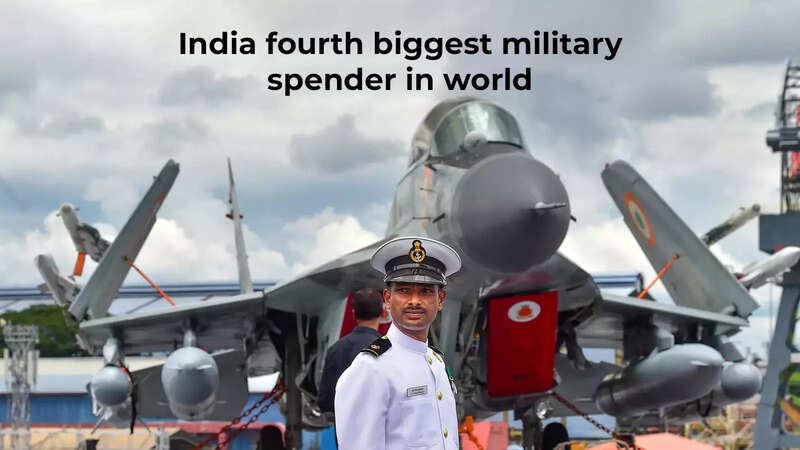
The allocation for defence during the fiscal year 2022–2023 stood at ₹525,166 crore (equivalent to ₹5.6 trillion or US$65 billion in 2023), an increase of nearly 10% over the previous year. making it the fourth highest in the world after the US, China, and Russia.
2023–2024
The defence expenditure for fiscal year 2023–2024 stood at ₹593,538 crore (US$69 billion).
2024–2025
The defence budget of India was increased to ₹621,940 crore (US$73 billion) in the 2024-2025 union budget from ₹593,538 crore (US$69 billion) during last year. This year’s defence budget accounts for 1.89% of the country’s projected gross domestic product (GDP) for 2024-25.
2025–2026
The defence budget of India was ₹681,210 crore (US$80 billion) This year’s defence budget accounts for 1.9% of the country’s projected gross domestic product (GDP) for 2025-26, with a 9.5% increase from last year, with a significant portion allocated to salaries and pensions, and a focus on domestic procurement and modernization.
Spending as a percentage of GDP
The above statistics were collected by the World Bank up to 2018.
Capital acquisition
The above data was published by the Institute for Defence Studies and Analyses.
See also
- Union budget of India
- Railway budget of India
References
Bibliography
- Behera, Laxman Kumar (2015). "15: Changing contours of Indian defence expenditure". In Pant, Harsh V. (ed.). Handbook of Indian Defence Policy: Themes, Structures and Doctrines. Routledge. ISBN 9781317380092 – via Google Books.
Further reading
Books
- Ghosh, Amiya Kumar (1996). India's Defence Budget and Expenditure Management in a Wider Context. New Delhi: Lancer. ISBN 9781897829264.
- Cohen, Stephen P.; Dasgupta, Sunil (2013). Arming without Aiming: India's Military Modernization. Brookings Institution Press. ISBN 9780815724926.
Reports
- Sethi, Sanjay (2014), "Performance Measurement: A Model for the Department of Defence Production" (PDF), Centre for Land Warfare Studies, New Delhi. Manekshaw Paper No. 46, KW Publishers
Journals
- Navlakha, Gautam (1999). "Defence Spending: Cost of Fighting Imaginary Enemies". Economic and Political Weekly. 34 (19): 1085–1088. ISSN 0012-9976. JSTOR 4407922.
News
- "Defence Procurement Policy". Press Information Bureau, Government of India. 24 March 2017. Retrieved 23 March 2021.
- Philip, Snehesh Alex (9 August 2020). "Artillery guns, assault rifles, AFVs — Here's a list of 101 items MoD won't import in future". ThePrint. Retrieved 23 March 2021.