The Armenian Assembly of America (Armenian: Ամերիկայի Հայկական Համագումար) is the largest Washington-based nationwide organization promoting public understanding and awareness of Armenian issues. The organization aims to "strengthen United States/Armenia relations, promote Armenia's democratic development and economic prosperity, and seeks universal affirmation of the Armenian genocide" via "research, education and advocacy." Its headquarters is in Washington, D.C., and it has offices in Glendale, California and Yerevan, Armenia.
History
In the early 1970s, at a time when Armenian-American advocacy was dominated by the Armenian Revolutionary Federation-aligned Armenian National Committee of America, the Armenian Assembly of America was created in Washington, D.C. as a non-partisan alternative dedicated to represent and promote Armenian interests. The key founding members were contributors to the Armenian General Benevolent Union, the largest remaining non-Armenian Revolutionary Federation Armenian organization in the United States.
The Assembly would go on to launch a broad array of programs and initiatives and firmly establish itself as an Armenian voice within U.S. public policy circles. It would pioneer initiatives to commemorate and reaffirm the Armenian genocide. And as early as 1977, the Assembly would introduce a summer intern program in Washington, DC that, some 32 years later, could claim more than 900 graduates.
Beginning in 1988 and thereafter, the Assembly addressed the unprecedented challenges of the 1988 Armenian earthquake, the Nagorno-Karabakh conflict and Armenia's independence movement.
With Administration support, the United States Congress mandated first-ever earthquake relief funding to then Soviet Armenia. Annual U.S. assistance became the norm, the next ten years totaling more than $1.4 billion. The Assembly was also instrumental in encouraging our friends in Congress to form a Congressional Caucus on Armenian Issues. It would become one of the largest caucuses, working side-by-side with the Assembly in supporting Armenian-American interests.
The Armenia Tree Project (ATP) was established in 1993 to assist the Armenian people in using trees to advance their social, economic and environmental recovery. Some 300,000 plantings later, ATP's vision continues to bloom throughout Armenia and Artsakh.
Efforts also continued unabated to secure universal reaffirmation of the Armenian genocide, enhanced significantly in 1997 with the launch of the Assembly's Armenian National Institute (ANI). ANI is at the forefront of efforts to affirm the Armenian genocide, responding to denial and advance knowledge and understanding of the Genocide and its consequences.
Completing three decades of non-partisan service, the Assembly family of organizations remains in the forefront of strengthening the U.S./Armenia and U.S./Artsakh relationships.
Following the 2020 Beirut explosion, the Assembly urged additional American support for Lebanon, with executive director Bryan Ardouny stating that "Lebanon holds a special place in our hearts and minds with its religious, educational, cultural and social institutions all serving the Armenian community and beyond."
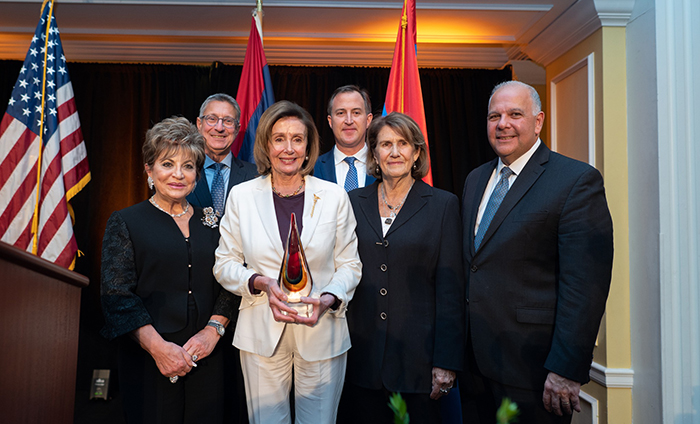
In 2022, the Assembly celebrated its fiftieth anniversary at the Jonathan Club in Los Angeles. There, professors Richard Hovannisian and Dennis Papazian, received the Distinguished Humanitarian Award, and Los Angeles's first Deputy Mayor of International Affairs, Nina Hachigian, received the Assembly's Governor George Deukmejian Award for Public Service. Another celebration, in Washington, honored Speaker of the House of Representatives, Nancy Pelosi, with the Assembly's Ambassador Henry Morgenthau Award for her strong support of and leadership on American affirmation of the Armenian genocide.
Actor Joe Manganiello joined the Assembly's 2025 Advocacy Summit in Washington, D.C., and was a keynote speaker at the United States Congress' Armenian genocide commemoration.
NGO Training and Resource Center
In April 1994, the Armenian Assembly of America established the NGO Training and Resource Center with support from the "Save the Children" USAID fund. The center aims to strengthen domestic Armenian Non-Governmental Organizations (NGOs) in hopes of encouraging wider participation in the democratic processes. The center provides, to more than 300 local registered NGOs, the following services:
- ten-week training program focusing on the leadership and management of the organization;
- technical assistance to help participants implement change within their organization;
- public relations department to raise public awareness about NGO Sector in Armenia and to promote their activities and projects;
- seminar/workshop series.
Spending
According to OpenSecrets.org, the Armenian Assembly of America allocated the following sums to its lobbying activities:
- 2000 - $270,000
- 2001 - $240,000
- 2002 - $140,000
- 2003 - $180,000
- 2004 - $220,000
- 2005 - $220,000
- 2006 - $180,000
- 2007 - $320,000
- 2008 -
- 2009 -
- 2010 -
- 2011 - $177,404
- 2012 - $28,681
- 2013 - $16,000
- 2014 - $30,000
- 2015 - $32,000
- 2016 - $35,600
- 2017 - $45,000
- 2018 - $95,000
- 2019 - $120,000
- 2020 - $90,000
- 2021 - $110,000
- 2022 - $110,000
- 2023 - $160,000
- 2024 - $210,000
See also
- Armenia–United States relations
- Armenian American Political Action Committee
- Armenian-American
- Armenian Diaspora
- Armenian lobby in the United States
- Armenian National Committee of America
- List of Armenian-Americans
- Little Armenia, Los Angeles, California
References
External links
- Official website